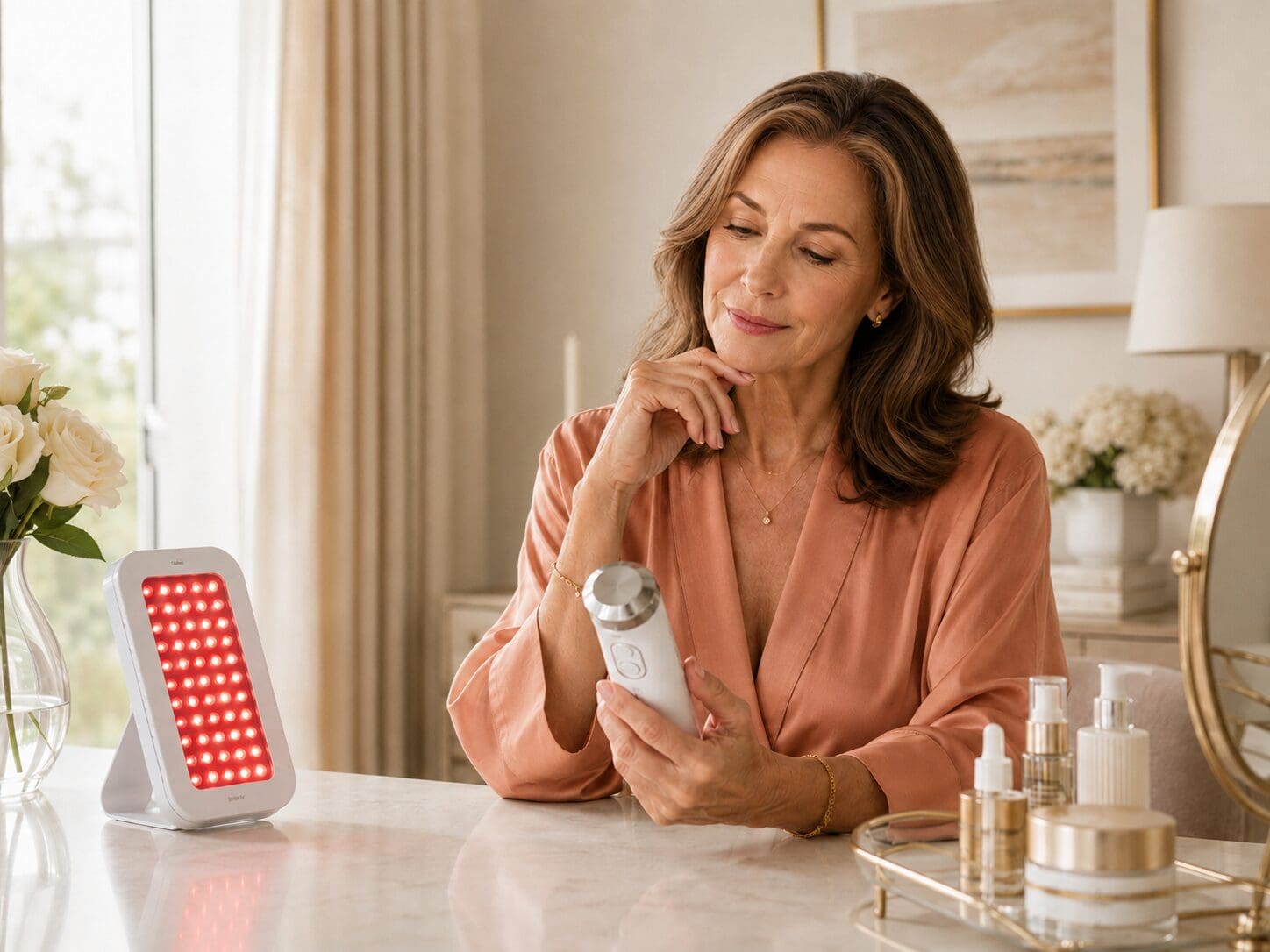
The Best At-Home Devices That Actually Help Mature Skin
August 7, 2026
You see the before-and-after on social media — smoother, firmer, noticeably lifted — and wonder whether a $300, $600, or $1,000 device might finally be the thing that makes a difference. The at-home device market is confusing for exactly this reason: technologies with genuinely reasonable evidence behind them sit right alongside products making claims far beyond what any home device can realistically deliver.
At Ageless Glow, our position is simple. The best device is not the most expensive or most powerful one. It’s the one that addresses the right concern, uses a reasonable technology, and is safe enough for you to use consistently. More technology is not automatically better skincare.
Why Mature Skin Responds Differently to Devices
Skin changes with age in ways that matter for how it responds to any technology, not just to products. Collagen production tends to become less robust over time, skin may become thinner or drier, and barrier recovery may take longer than it once did. Hormonal changes can affect hydration and elasticity, mature skin may be more reactive to aggressive treatment, and cumulative sun exposure may already be affecting texture and pigmentation.
None of this means mature skin is fragile or off-limits to technology. It means gentleness and consistency deserve more weight than intensity — a theme that will come up again and again in this article.
Where Each Category May Fit
Different home devices use different energy outputs, wavelengths or frequencies, treatment protocols, regulatory pathways, and levels of clinical evidence — and evidence from one studied device cannot automatically be generalized to every product using the same broad technology. What follows is a practical comparison of categories worth understanding, not a scientific ranking from most to least proven.
| WONDERING WHAT ELSE MIGHT BE AFFECTING YOUR RESULTS? The free Ageless Glow guide, The 5 Hidden Reasons Your Skin Isn’t Improving After 50, helps you look at the fuller picture around your routine — not just the products themselves. GET THE FREE GUIDE → |
1. Red-Light / LED Therapy
Red and near-infrared light are forms of photobiomodulation. Controlled studies on particular red or near-infrared LED devices have reported improvements in skin appearance or wrinkle-related outcomes, though at-home devices generally deliver lower intensity than professional equipment, and consistency matters more than any single session.
Not every red-light mask is clinically equivalent. Wavelength, irradiance or energy dose, treatment time, device design, and consistency of use all matter, and higher power is not automatically better. LED has a reasonable and growing evidence base, but the evidence is device- and protocol-specific — follow the manufacturer’s guidance on eye protection for your particular device rather than assuming one rule applies to all LED products.
Women may reasonably hope LED supports gradual improvement in overall skin quality, a subtle softening in the appearance of fine lines, calmer-looking skin, and general radiance. LED should not be expected to dramatically lift sagging tissue, erase deep wrinkles, replace laser resurfacing, or permanently tighten loose skin.
Ageless Glow Assessment: LED is one of the more reasonable first home-device categories for many women, largely because it’s generally low-intensity and fits well into a consistent routine when used according to manufacturer instructions. This doesn’t mean it’s appropriate for everyone.
2. Microcurrent
Microcurrent delivers a very low-level electrical current and is commonly marketed for facial toning and contour. Research on electrical stimulation and facial aesthetics does exist, but terminology and protocols vary considerably across studies — some research evaluates NMES (neuromuscular electrical stimulation) rather than consumer microcurrent specifically, and much of the evidence is device-specific. Long-term structural lifting claims are not established across the category as a whole.
Some users notice a temporary, more ‘lifted’ or refreshed appearance, though effects tend to depend heavily on repeated, consistent use. It’s worth being precise about the distinction between a temporary visual improvement and permanent structural lifting — microcurrent should not be presented as permanently rebuilding or restructuring facial muscles. Realistic benefits may include a temporary improvement in facial appearance, a temporary contouring effect, facial muscle stimulation for some users, and the simple value of a consistent ritual.
Maintenance is generally required, dramatic lifting claims deserve skepticism, and effects vary significantly between individuals. Anyone with an implanted electrical or medical device, or a relevant health condition, should follow manufacturer and medical guidance before use.
3. EMS / Electrical Muscle Stimulation
EMS and microcurrent are not identical technologies, and it’s worth keeping them separate. EMS generally produces more noticeable muscle contraction than typical microcurrent devices and is increasingly used in facial beauty devices, often marketed with promises of lifting and facial sculpting.
There is some emerging research on facial muscle stimulation, but this doesn’t justify broad claims that all home EMS devices permanently lift or reshape the face — research involving professional or combined RF/electrical systems cannot automatically be generalized to an inexpensive consumer EMS device. Potential experiences may include temporary muscle stimulation, temporary contour changes, and a greater awareness of facial musculature — not permanent lifting or reshaping.
4. Radiofrequency
Radiofrequency deserves extra care, partly because it’s so heavily marketed. Noninvasive home RF devices use radiofrequency energy to generate controlled tissue heating, generally at lower power than professional systems. Some specific home RF devices have been studied with encouraging results for measures such as fine lines, texture, elasticity, or firmness — but these results are device-specific and shouldn’t be generalized to every RF device on the market. More heat is not automatically more effective, and temperature control and safety design matter a great deal here.
It’s important not to confuse noninvasive home RF with RF microneedling, which involves needles delivering RF energy into tissue and is a professional procedure with a meaningfully different risk profile. If you encounter warnings about burns, scarring, fat loss, nerve injury, or disfigurement associated with RF, those warnings generally relate to certain uses of RF microneedling specifically — not ordinary noninvasive home RF devices. For home RF, focus on manufacturer instructions, approved treatment zones, device quality, temperature and safety controls, and listed contraindications.
Ageless Glow Position: RF may be useful for the right person and the right device, but it’s not a category to approach casually or aggressively.
5. At-Home Laser and Light-Based Devices
“Laser” is often used loosely in beauty marketing, so it helps to clearly distinguish between true laser technology, LED, IPL, and other light-based systems — a device marketed online as “laser” isn’t necessarily a genuine, compliant home laser. Some true home-use nonablative laser devices have clinical evidence for specific wrinkle or texture concerns, but those findings are specific to the studied device and protocol, not the category as a whole.
A realistic expectation for a genuine home laser device designed for fine lines or a limited facial area is gradual improvement in fine lines or texture within the targeted zone. Results take time, and home systems are meaningfully less powerful than professional lasers — deeper wrinkles and significant laxity generally call for professional-level treatment to see substantial change.
Use these devices only in their manufacturer-designated treatment areas. Eye safety deserves particular care, and skin tone or pigmentation history can affect whether a particular light-based technology is appropriate — check manufacturer warnings and appropriate regulatory status before use.
A Note on Regulatory Language
Phrases like “FDA registered” or “FDA certified” are not automatically the same as a device being FDA cleared or approved for a specific intended use. Regulatory clearance and clinical effectiveness are related questions, but they are not the same question — a device can be registered with the FDA in a general sense without having clearance for the specific cosmetic claim being made about it. If you’re in the United States and want to verify a specific claim, official FDA device databases are the most reliable source. The FDA has also noted that some laser products sold online may not meet federal safety requirements or may be intended only for trained or professional users, which is worth keeping in mind when shopping.
“Medical grade” is a phrase used loosely in consumer beauty marketing, too. On its own, it isn’t proof of FDA status, professional-level performance, superior energy output, safety, or clinical effectiveness. It’s worth looking past the phrase to the actual technology, intended use, manufacturer information, regulatory status, published research, warnings, and treatment instructions.
6. Facial Massage, Gua Sha, and Vibration Devices
These lower-tech tools still deserve a place in this discussion. Potential benefits include relaxation, a temporary reduction in mild puffiness, improved comfort, a greater awareness of facial tension, and simply an enjoyable ritual — themes covered in more depth in Fascia and the Face: What Women Over 50 Should Understand and The Hidden Causes of Morning Puffiness. These tools should never be presented as fascia remodeling, permanent facial lifting, toxin removal, bone reshaping, or fat reduction. Ageless Glow favors light pressure over aggressive scraping, always.
Where Each Technology May Fit
This is educational guidance, not individualized medical advice, but a few general starting points may help:
- Fine lines and overall skin quality: LED / red light has been studied for these concerns and may be worth learning more about
- Temporary facial contour: microcurrent may be of interest, with modest, temporary expectations
- Firmness as a priority: some home RF devices have supportive evidence, but device quality and safe heating matter a great deal
- A specific wrinkle area: a targeted home laser device may be relevant, depending on the exact technology
- Puffiness and tension: gentle movement, massage, or low-tech tools are often sufficient if the issue is temporary and non-medical
This isn’t a prescription telling every woman with a given concern to buy one specific device category — it’s a starting point for further reading.
The Device Mistake Women Over 50 Often Make
The most common mistake is not choosing the wrong device — it’s using too many at once. Combining radiofrequency, microcurrent, exfoliation, retinoids, peels, and LED without much thought increases complexity, may increase cumulative irritation depending on the specific technologies involved, and makes it genuinely harder to identify what caused a reaction. It may also conflict with individual manufacturer instructions. Some women mistake that irritation for evidence something is ‘working,’ increase frequency when results aren’t immediate, switch devices too quickly to know what actually helped, and end up straining the skin barrier in the process of trying to improve aging skin.
Mature skin often benefits more from a well-tolerated routine used consistently than from an aggressive schedule filled with overlapping treatments. Where timing between devices or actives matters, follow the specific manufacturer’s guidance and professional advice rather than a generic rule of thumb. If irritation from device overuse sounds familiar, it’s worth reading How to Support a Compromised Skin Barrier After 50.
| BEFORE ADDING TECHNOLOGY, START WITH THE ROUTINE UNDERNEATH IT Before adding technology, make sure the skincare routine underneath it is understandable and purposeful. The Ageless Glow Starter Kit can help you audit what you already own and build a simpler routine your skin can actually tolerate. EXPLORE THE AGELESS GLOW STARTER KIT → |
A Word on Online Marketplace Listings
Be cautious of listings from anonymous or unclear manufacturers, vague technical specifications, “professional strength” claims without explanation, missing manuals, unclear treatment zones or contraindications, devices claiming multiple unrelated technologies without explaining any of them, and dramatic results promised within days. A sophisticated-looking product listing is not the same as a well-documented device.
How to Evaluate a Device Before Buying It
Before spending money, a few honest questions can save both money and skin:
- What exact technology does the device actually use?
- What specific cosmetic concern is it designed to address?
- Is the manufacturer clearly identifiable?
- Are treatment zones clearly stated?
- Are wavelength, frequency, or energy specifications disclosed when relevant?
- Are contraindications and warnings easy to find?
- Is the device actually intended for home use?
- Is the company’s FDA or regulatory wording precise — registered/certified versus actually cleared or approved for this use?
- Is there credible, published research on this exact device — or only on the broader technology in general?
- Was that research company-sponsored?
- Are before-and-after images standardized for lighting, angle, expression, and timing?
- Will I realistically use it according to instructions?
Published research on a technology doesn’t guarantee that a specific product will deliver the same results — it’s simply one useful piece of information among several. A device sitting unused in a drawer cannot outperform a simpler device you will actually use.
When a Professional Treatment May Make More Sense
Home devices have real limitations. Professional treatment may be more appropriate for substantial skin laxity, significant pigmentation concerns, vascular lesions, scarring, suspicious or new or changing skin lesions, significant texture changes, or any condition that requires diagnosis. This doesn’t mean every professional treatment automatically works better than every home option — simply that professional care allows individualized diagnosis, access to stronger technologies where appropriate, and supervised treatment. A qualified dermatologist or licensed professional is the right resource for these situations, not a home device, regardless of how it’s marketed.
Safety and Contraindications
Contraindications are device-specific, so it isn’t accurate to offer one blanket list that applies to every technology in this article. People with implanted electronic devices, pregnancy, photosensitizing conditions or medications, seizure disorders, active skin disease, recent procedures, pigment concerns, or other medical issues may need specific guidance depending on the exact technology involved — not every condition is a contraindication for every device. The manufacturer’s instructions and qualified healthcare guidance should always take priority over general advice like this article.
Eye Safety
Different devices have different eye-safety requirements, so it isn’t accurate to say ‘always wear eye protection’ applies identically to every LED or light-based product. Follow the eye-safety instructions provided for the specific device you’re using, and never use laser or light-based equipment outside its approved treatment area or contrary to its labeling.
What Ageless Glow Would Prioritize First
This is an editorial decision framework, not a scientific ranking, and it’s not an absolute order for every person. For a woman starting from scratch, Ageless Glow would generally favor technologies with reasonable evidence, conservative energy delivery, transparent specifications, and a routine she can realistically maintain.
- Often a reasonable starting point for many women — Red-Light / LED Therapy: low-intensity, consistency-friendly, and relevant to overall skin quality
- Useful for temporary facial contour — Microcurrent: can be enjoyable and may temporarily improve facial appearance, but requires ongoing maintenance
- More advanced — Radiofrequency: potentially useful, but greater attention to device quality, heat, and safe use is required
- Targeted option — At-Home Laser: may be useful for specific fine-line concerns depending on the technology
- Optional wellness tools — Massage / Gua Sha / Vibration: useful primarily for relaxation, comfort, and temporary puffiness, not structural lifting
How Devices Fit Into the Ageless Glow Healthy Foundation Approach
Healthy-looking skin is still supported by the same foundation we return to throughout this series: facial muscle awareness, fascia and comfortable movement, normal fluid balance, a healthy skin barrier, and thoughtful skincare and technology built alongside all of it. Devices are optional tools that sit within this broader picture, not a final anatomical ‘layer’ above it. An expensive device is unlikely to be useful if the routine around it repeatedly irritates the skin or if foundational steps such as sun protection and barrier comfort are being neglected.
A Calm Conclusion
The home-device market does contain technologies worth considering. But no single tool deserves to become the center of your skincare routine. The best results usually come from understanding what a device can realistically do, using it consistently, and giving your skin enough time and support to respond.
The goal is not to own every device. It is to know which tools deserve a place in your routine — and which ones do not.
| THE DEVICE RULE Do not choose a device because it promises the biggest transformation. Choose it because the technology matches your concern, the expectations are realistic, and you can use it safely and consistently. |
Read Next
- How to Support a Compromised Skin Barrier After 50
- What Facial Tension May Be Doing to the Way Your Face Looks
- Fascia and the Face: What Women Over 50 Should Understand
| GET THE FREE GUIDE Ready to look more closely at what your skin may actually need? The 5 Hidden Reasons Your Skin Isn’t Improving After 50 is a calmer, clearer way to evaluate your routine. GET THE FREE GUIDE → |
