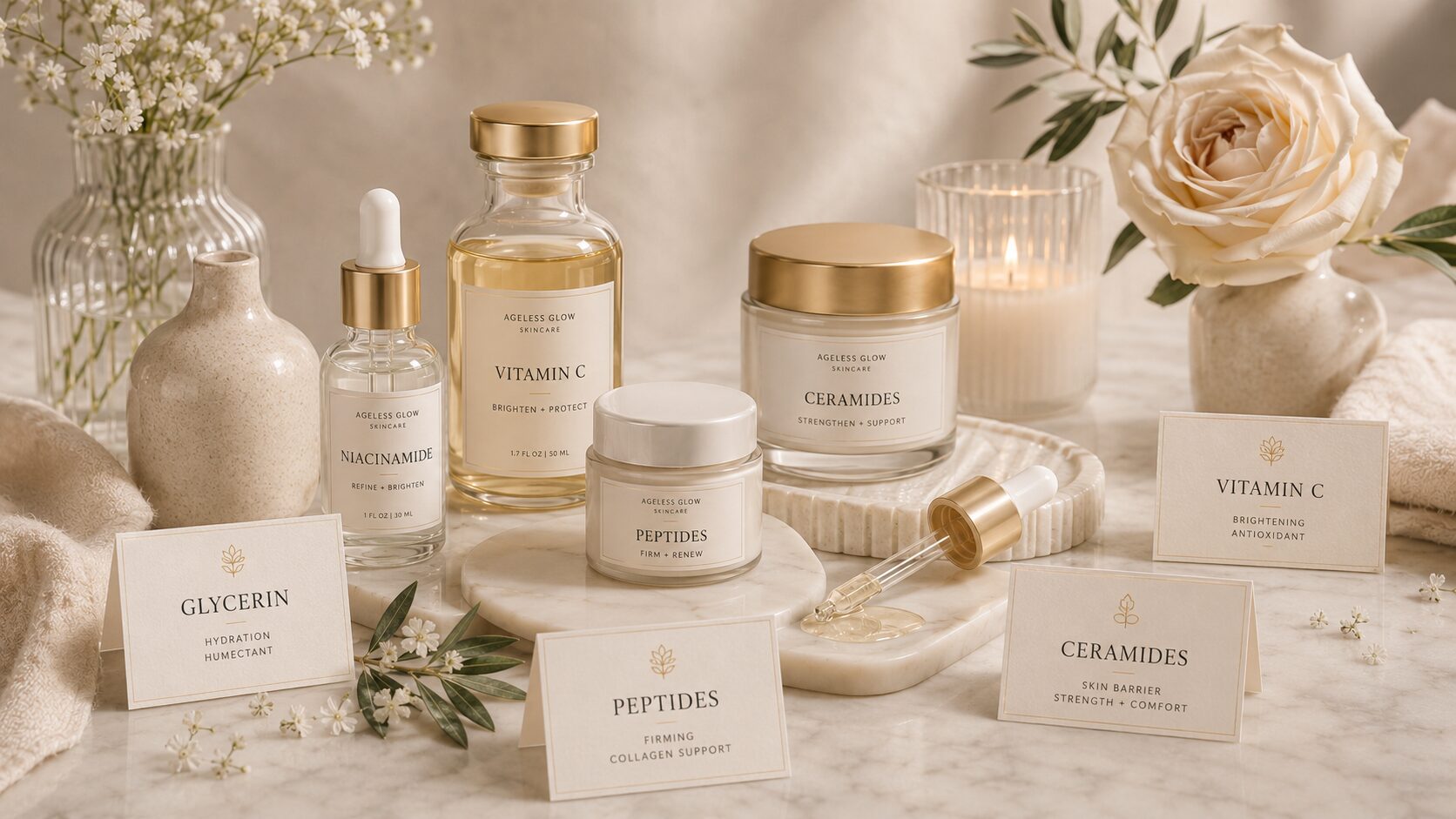
The Mature-Skin Ingredient Guide: What Helps, What Irritates, and What to Use Carefully
August 10, 2026
Open the skincare cabinet of almost any woman over 50 and you’ll likely find vitamin C, retinol, peptides, niacinamide, an acid or two, ceramides, a handful of moisturizers, and probably a few products purchased because someone online called them a ‘must-have.’ The problem, at this point, is rarely finding skincare. The problem is knowing what actually deserves a place in the routine — and what’s simply taking up shelf space while doing very little.
Mature skin rarely needs every trending ingredient. It needs the right ingredients, in the right formulation, used with enough consistency — and enough restraint — to remain comfortable and supported. This guide is meant to help you tell the difference, without turning your routine into a research project.
Why Mature Skin May Respond Differently to Active Ingredients
With age, skin may experience changes in dryness, barrier recovery, natural oil production, sensitivity, and hydration — though this varies quite a bit, and it isn’t true of every woman over 50 in the same way. Cumulative sun exposure, hormonal shifts, and a lower tolerance for aggressive routines can play a role for some women as well. None of this means mature skin is fragile or damaged — it simply means the same ingredient, at the same strength, can behave differently on skin at 55 than it did at 25, and it can behave differently from one woman’s skin to the next at any age.
Age can change what your skin tolerates, but chronological age alone does not determine your ideal routine. This is worth taking seriously without taking it as bad news. It’s simply useful information — the kind that helps you choose products more intelligently instead of by trial, error, and irritation.
The goal is not to avoid effective ingredients. It is to use them intelligently.
| WONDERING WHAT ELSE MIGHT BE AFFECTING YOUR RESULTS? The free Ageless Glow guide, The 5 Hidden Reasons Your Skin Isn’t Improving After 50, helps you look at the fuller picture around your routine — not just the products themselves. GET THE FREE GUIDE → |
The Mature-Skin Ingredients Worth Understanding First
1. Ceramides
Ceramides are naturally present in the skin barrier, forming part of the lipid structure that helps reduce water loss and support the barrier’s overall function. They can be especially useful when skin feels dry, tight, or easily irritated, and ceramide-containing moisturizers are a genuinely valuable addition to even the simplest routine — often more valuable than a more ‘exciting’ serum layered on top of compromised skin. That said, dryness, tightness, or irritation can have several causes, so those symptoms don’t automatically mean a person is specifically ‘missing ceramides’ — a ceramide-containing moisturizer is a reasonable place to start, not a diagnosis.
Ageless Glow Takeaway: ceramides are not glamorous, but they are foundational.
2. Glycerin
Glycerin is a humectant — it helps attract water into the outer layers of skin — and it’s used widely in well-formulated skincare across every price point, from drugstore basics to luxury formulations. Mature skin does not always need exotic ingredients to benefit, and glycerin is proof of that. It tends to work best as part of a complete moisturizing formula rather than as a standalone treatment for mature skin — the finished formulation matters more than glycerin working in isolation.
It’s an Ageless Glow favorite precisely because of its simplicity and practicality, not because of any exaggerated claim.
3. Peptides
‘Peptides’ is a broad category, not a single ingredient, and different peptides have different intended roles within a formulation. Concentrations vary, delivery and formulation vary, and evidence from one specific peptide or finished product should not be generalized to peptide skincare as a whole. Some peptide-containing products may support smoother or healthier-looking skin, but the evidence is highly product-specific — marketing often makes peptides sound more transformative than the available evidence actually supports.
Peptides may be a useful supportive ingredient in a well-rounded routine. They are not equivalent to a facelift, an injectable treatment, or a professional procedure, and it’s worth reading peptide claims with a healthy degree of skepticism — no peptide serum, as a category, has been shown to broadly rebuild collagen, lift, or structurally transform skin.
4. Vitamin C
Vitamin C is best known for its antioxidant role and its relationship to environmental oxidative stress, and many women appreciate its support for brighter-looking, more even-toned skin. Different forms of vitamin C exist, and formulation and stability matter as much as the ingredient itself — some formulas can sting or irritate sensitive skin, and a higher concentration is not automatically better.
Morning use often pairs naturally with sunscreen, since both play a role in supporting skin against daily environmental exposure — but vitamin C isn’t required in every morning routine, no single formula is guaranteed to improve how your sunscreen performs, and vitamin C never replaces sunscreen as the essential protective step.
5. Retinoids
Retinoids are among the more established topical ingredients used for photoaged skin, though meaningfully different types and strengths exist — prescription retinoids, retinal or retinaldehyde, cosmetic retinol, and other retinoid derivatives are not clinically interchangeable, even though they’re often discussed as one category.
Irritation tends to increase when strength or frequency exceeds what your skin can comfortably tolerate, which is why a gradual introduction is commonly helpful for tolerability — especially for anyone new to retinoids or prone to irritation, at any age, rather than something mature skin specifically needs more than other skin does. A small amount, a few nights a week, building up slowly rather than starting at full strength, tends to work well for most people getting started.
A supportive moisturizer can often improve tolerability, and consistency at a level your skin tolerates tends to be far more useful than repeatedly starting and stopping an overly aggressive regimen. Watch for irritation, peeling, or sensitivity, and follow a clinician’s guidance closely if you’re using a prescription-strength product or have a relevant medical circumstance — there’s no universal frequency or amount that applies beyond what your specific product or clinician recommends.
6. Niacinamide
Niacinamide, a form of vitamin B3, may support barrier function, more even-looking tone, and overall skin comfort. Higher percentages don’t necessarily mean greater benefit, and formulation and individual tolerance matter as much as the number on the label — some users may experience irritation with certain formulas, though flushing-type reactions aren’t a defining or universal niacinamide experience. Choosing a moderate, well-formulated product is often a better strategy than chasing the highest concentration on the shelf — a genuine ‘less-but-better’ ingredient.
Ingredients That Deserve More Care
Exfoliating Acids
AHAs and BHAs can improve the look of texture and dullness for some women, but not all acids and formulas are equally strong or interchangeable — pH, concentration, vehicle, and intended use all vary considerably from product to product. Too much cumulative exfoliation can increase dryness, stinging, redness, and barrier disruption. Mature skin does not need to be aggressively exfoliated to look healthy — frequency and tolerance matter far more than intensity, and there’s no single schedule that applies to everyone.
Fragrance and Essential Oils
Fragrance is not automatically harmful, and many people tolerate fragranced products perfectly well. Others experience irritation or sensitivity, and women with more reactive skin may simply prefer to consider fragrance-free options. This is a matter of individual tolerance, not a reason for blanket fear around any one ingredient category — nor should every essential oil or fragrance ingredient be equated with allergy, toxicity, or photosensitivity as a group.
Three Ingredient Combinations That Can Overwhelm Mature Skin
None of these combinations are universally forbidden, and plenty of women use versions of them without any trouble at all. But stacking several potentially irritating products in the same routine can exceed an individual’s tolerance faster than any single ingredient would on its own — and it can make it genuinely difficult to figure out which product is responsible when something starts to feel wrong.
Retinoid + Strong Exfoliating Acid
Using them in the same routine, especially on the same night, may increase irritation risk depending on strength, formulation, frequency, and individual tolerance. This isn’t a claim that the two ingredients chemically cancel each other out or are universally unsafe together — it’s a caution about cumulative irritation for skin that’s sensitive to either one.
Multiple Exfoliating Products
An acid cleanser, an exfoliating toner, an acid serum, and a scrub may each seem mild individually, but duplication adds up quickly — it’s easy to be exfoliating far more than intended without realizing it.
Several Strong Actives Introduced at Once
Starting a retinoid, a vitamin C serum, an exfoliating acid, and a strong niacinamide formula all in the same week makes it nearly impossible to know what’s helping and what’s irritating your skin.
The problem is not always the ingredients themselves. Sometimes the problem is simply too much activity in one routine.
How to Build a Routine by Function — Not by Trend
Instead of collecting ingredients because they trended on social media last month, it helps to think about skincare by job. This is an educational simplification, not the only correct structure for every routine, but most products can be sorted into one of a few simple categories:
- Cleanse — remove makeup, sunscreen, and daily buildup without stripping the skin
- Treat — choose one or two targeted ingredients based on your main concern
- Moisturize — support hydration and barrier comfort
- Protect — use sunscreen consistently
Not every product needs to contain five active ingredients. A skincare routine should have a purpose before it has a product.
| READY TO SIMPLIFY BY FUNCTION, NOT BY TREND? If your skincare shelf has become more confusing than helpful, the Ageless Glow Starter Kit can help you step back, evaluate what you already own, and build a calmer routine around what your skin actually needs — an organizing tool, not a treatment. EXPLORE THE AGELESS GLOW STARTER KIT → |
Signs Your Routine May Be Doing Too Much
- Persistent tightness
- Burning or stinging
- Increased redness
- Flaking
- Swelling or rash-like changes
- Sensitivity to products that previously felt comfortable
- Skin that feels increasingly reactive
- Constantly changing products because nothing seems to work
These signs are worth taking seriously and reassessing your routine around, but they aren’t a self-diagnosis of barrier damage on their own. Persistent or severe symptoms deserve evaluation by a qualified healthcare professional, rather than another new product — and if this sounds familiar, How to Support a Compromised Skin Barrier After 50 is a good next read.
A Simple Way to Introduce a New Ingredient
- Add one meaningful change at a time
- Give the routine time before changing something else — different products have different expected timelines, so there’s no single universal number of weeks
- Follow manufacturer directions
- Use appropriate sunscreen
- Notice comfort as well as appearance
- Stop or reduce use if significant irritation develops
- Seek professional guidance for persistent reactions or medical skin concerns
How This Fits Into the Ageless Glow Healthy Foundation Approach
Thoughtful skincare is one topic within the broader Healthy Foundation educational framework, alongside facial tension and movement, fascia, normal lymphatic and fluid movement, skin-barrier health, and optional technology. These aren’t anatomical layers where one must be corrected before the next — thoughtful skincare is one part of the foundation picture, alongside barrier health, sun protection, and the broader habits that influence how skin looks and feels.
Products matter, but they work within a larger context that includes sleep, nutrition, hydration, stress, movement, consistency, and realistic expectations — these habits complement thoughtful skincare rather than being proven, direct causes of specific visible skin outcomes on their own. Skincare becomes much easier when products stop being the entire strategy and become one thoughtful part of it.
A Calm Conclusion
Women over 50 do not need every trending serum. They need a few well-chosen ingredients, a routine with a clear purpose, enough consistency to evaluate results, enough restraint to protect the skin barrier, and realistic expectations about what any product can do. That’s a far calmer standard than the one most skincare marketing sets — and a far more achievable one, week after week, without needing to reinvent your routine every time a new ingredient trends online.
Mature skin does not need to be pushed harder. It needs to be understood better.
| THE AGELESS GLOW INGREDIENT RULE Do not choose an ingredient because it sounds powerful. Choose it because it serves a clear purpose, your skin tolerates it, and you can use it consistently. The best routine is not the one with the most actives. It is the one your skin can live with. |
Read Next
- How to Support a Compromised Skin Barrier After 50
- The Evening Skincare Routine Mature Skin Needs After 50
- At-Home Skincare Devices After 50: What May Actually Be Worth Considering
| GET THE FREE GUIDE Ready to look more closely at what your skin may actually need? The 5 Hidden Reasons Your Skin Isn’t Improving After 50 is a calmer, clearer way to evaluate your routine. GET THE FREE GUIDE → |
