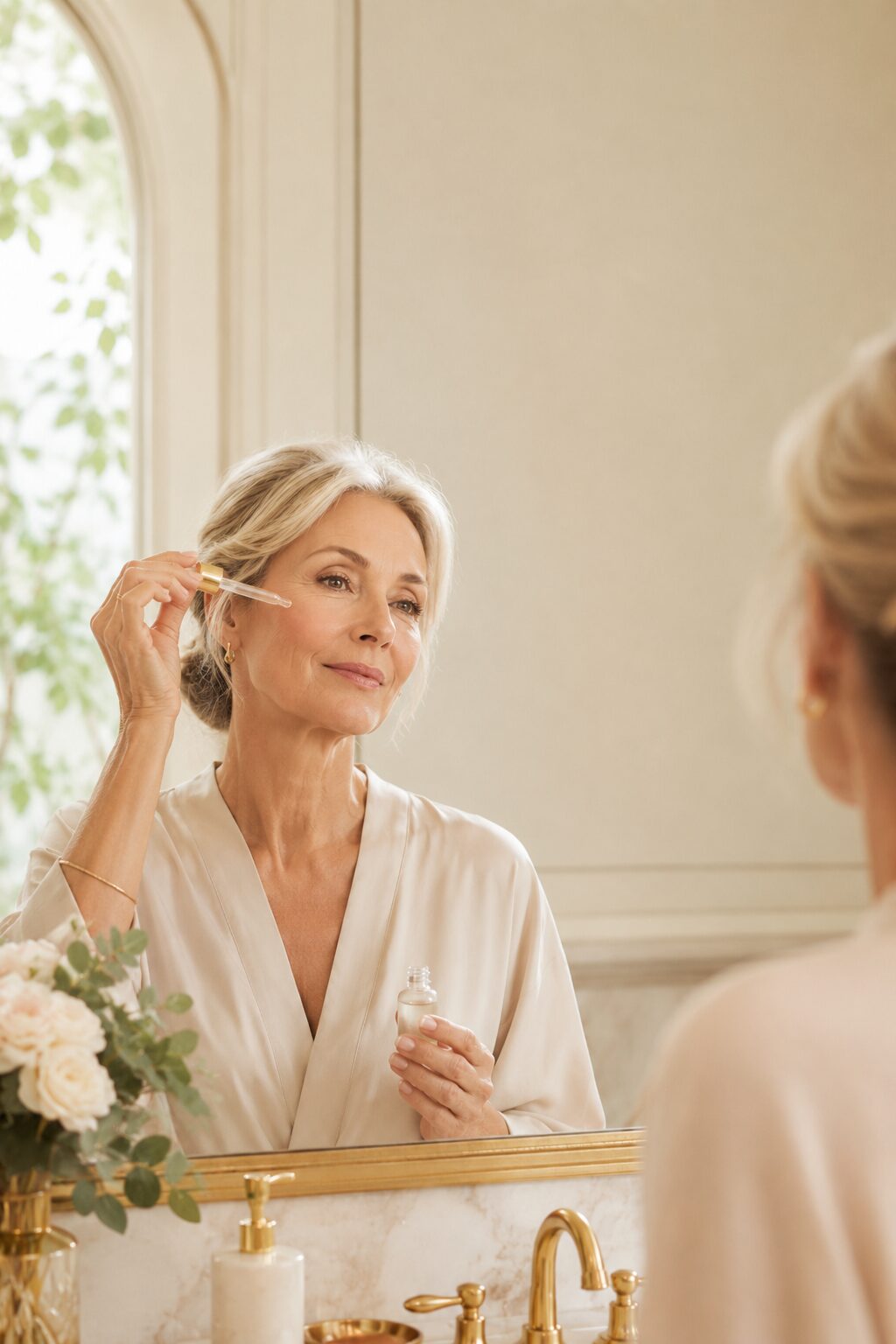
The Evening Skincare Routine Mature Skin Needs After 50
August 6, 2026
Morning skincare gets most of the attention. Sunscreen, antioxidants, the products meant to protect you before you walk out the door — these tend to dominate the conversation. But evenings deserve just as much thought, especially once you’re past 50. During the day, skin is largely occupied with defense — buffering UV, pollution, wind, and dryness.
At night, with those demands eased, skin has more room to focus on renewal and barrier support, following its own natural circadian rhythm. If your evening routine is simply your morning routine repeated, it may be worth rethinking.
Why Nighttime Is a Different Job for Your Skin
Skin doesn’t switch cleanly from ‘defense mode’ to ‘repair mode’ the moment the sun goes down — it’s less an on/off switch and more a shift in emphasis, following patterns tied to your body’s circadian rhythm. Certain renewal and barrier-related processes do tend to be more active overnight, which is part of why an evening routine can reasonably look a little different from a morning one.
That doesn’t mean night is only for restoration and never for treatment. Actives like retinoids are often used at night for good reason — the goal of an evening routine is less about avoiding actives altogether and more about balancing any treatment step with genuine barrier comfort and recovery.
Start by Removing the Day, Gently
Before anything else can help your skin, the day has to come off: sunscreen, makeup, and the invisible layer of oil and environmental buildup that accumulates by evening. This step creates the clean, comfortable foundation your evening products need.
Is Double Cleansing Necessary?
Double cleansing — an oil or balm cleanser followed by a gentle water-based one — can be useful if you wear long-wearing makeup or mineral sunscreen. It isn’t, however, a requirement for everyone. If your makeup is light and your sunscreen rinses away easily, one thorough cleanse may be all your skin needs. More steps aren’t automatically better; the goal is simply a clean, comfortable face, not a lengthy ritual for its own sake.
Mind the Water and the Cleanser
Hot water feels soothing after a long day, but it can strip the skin’s natural oils and leave mature skin feeling tighter than before you started. Lukewarm water is gentler. Cleanser texture matters less than how your skin feels afterward — some foaming formulas are genuinely drying, while others are well formulated and perfectly comfortable. The more useful principle is simply this: your cleanser should leave skin feeling clean, not tight, stripped, or irritated.
| WONDERING WHAT ELSE MIGHT BE AFFECTING YOUR RESULTS? The free Ageless Glow guide, The 5 Hidden Reasons Your Skin Isn’t Improving After 50, helps you look at the fuller picture around your routine — not just the products themselves. GET THE FREE GUIDE → |
Layer From Lightest to Richest
Once skin is clean, a helpful general rule of thumb is to apply products in order of texture — thinner, water-based formulas first, followed by creams, with any oil last. This isn’t a universal law, though: formulation varies, manufacturer directions matter, and certain prescription or treatment products may come with their own specific application instructions worth following over a general rule.
There’s no need to apply every product you own in a single evening. Fewer, well-chosen steps tend to be easier to tolerate, easier to evaluate, and easier to actually maintain than a crowded routine.
Introducing Retinoids and Other Actives With Patience
Retinoids and similar active ingredients are often associated with supporting the look of fine lines and uneven texture over time, but they aren’t something to introduce all at once. A gradual approach — starting with a small amount, a few nights a week, and slowly building tolerance — tends to be more comfortable for mature skin than jumping in at full strength.
It’s worth remembering that retinoids, exfoliating acids, vitamin C, and other treatments don’t all behave the same way — each has its own uses, tolerability, and application guidance, so there’s no single schedule that applies to all of them equally, let alone to every woman. If you have a history of sensitivity, rosacea, or another skin concern — or you’re working with a prescription-strength product — it’s worth discussing timing and strength with a dermatologist before adding anything new.
Why Mature Skin May Not Tolerate Everything at Once
It can be tempting to combine a retinoid, an exfoliating acid, and a vitamin C serum in the same routine, hoping for faster results. The concern isn’t that these ingredients are inherently incompatible — it’s that when several strong treatments are introduced or layered together, it becomes harder to identify what’s helping and what may be irritating the skin.
Skin that’s already navigating natural, age-related changes in barrier function often responds better to one active ingredient introduced at a time, used consistently, than to several competing for attention on the same night.
| READY TO SIMPLIFY YOUR EVENING ROUTINE? If your nightstand has become a lineup of competing actives, the Ageless Glow Starter Kit can help you audit what you already own and build a simpler, more purposeful evening routine. EXPLORE THE AGELESS GLOW STARTER KIT → |
Let Moisturizer Do Its Job
A supportive moisturizer isn’t an afterthought — it’s one of the more important steps in an evening routine. Depending on the formulation and your skin’s needs, ingredients such as ceramides, glycerin, squalane, and other humectants or emollients can help skin retain moisture and support a healthier-feeling barrier overnight. There’s no single ingredient family that every mature complexion universally requires — what matters is finding a formulation that genuinely suits your skin, which becomes more meaningful as skin’s own lipid production naturally slows with age.
Facial Oils: A Final, Optional Step
Facial oils can be a pleasant final layer for those with drier skin, helping to seal in the products applied underneath. They aren’t essential for every skin type. Oils are typically used near the end of a routine simply because they’re richer and can change how anything layered afterward spreads or absorbs — rather than because oil applied earlier categorically blocks treatments from working. If you’re using a specific treatment product, following its own directions is more reliable than leaning on a general layering rule. If you choose to use a facial oil, apply it last, and use a light hand — a few drops go further than most people expect.
Extend the Routine Beyond Your Jawline
The neck, chest, and backs of the hands are often left out of the evening routine entirely, even though they experience much of the same exposure as the face. These areas are commonly neglected and deserve thoughtful moisturizer and sun protection too. Because the skin here tends to be thinner and more irritation-prone, it’s worth introducing stronger actives to the neck and chest more cautiously and gradually than you might on your face.
Consistency Matters More Than a Ten-Step Routine
It’s easy to assume that more products or more steps signal more care. In practice, a routine that’s comfortable, purposeful, and sustainable is generally easier to evaluate and maintain than one that’s unnecessarily complicated — not because shorter is automatically better, but because a routine you can actually stick with, night after night, tends to outperform one you follow sporadically. Skin benefits from a predictable environment, and consistency is often the single most useful habit you can build.
Sleep, Stress, and Your Overnight Environment
What happens around your skincare routine matters too. Poor sleep and ongoing stress are associated with a range of effects on the body, and skin isn’t exempt — many people notice their complexion looks more tired or feels less resilient after a stretch of disrupted sleep. A cooler room, a clean pillowcase, and a consistent bedtime won’t replace good skincare or directly repair skin on their own, but they support the same broader goal: giving your body a calm, stable environment to rest in.
| EVENING PRINCIPLE Your nighttime routine doesn’t need to be complicated. It needs to remove the day gently, support the barrier, and give your skin a consistent environment in which to recover. |
An evening routine like this is really just one part of a larger healthy-aging foundation — alongside sleep, sun protection, and consistency — rather than an isolated beauty ritual on its own.
Read Next
- The Morning Routine That Supports Healthy Aging Skin
- How to Rebuild a Struggling Skin Barrier After 50
- Why Fewer Skincare Products Can Give Mature Skin Better Results
| GET THE FREE GUIDE Ready to look a little closer at what your skin may actually be missing? The 5 Hidden Reasons Your Skin Isn’t Improving After 50 is a good place to start. GET THE FREE GUIDE → |
