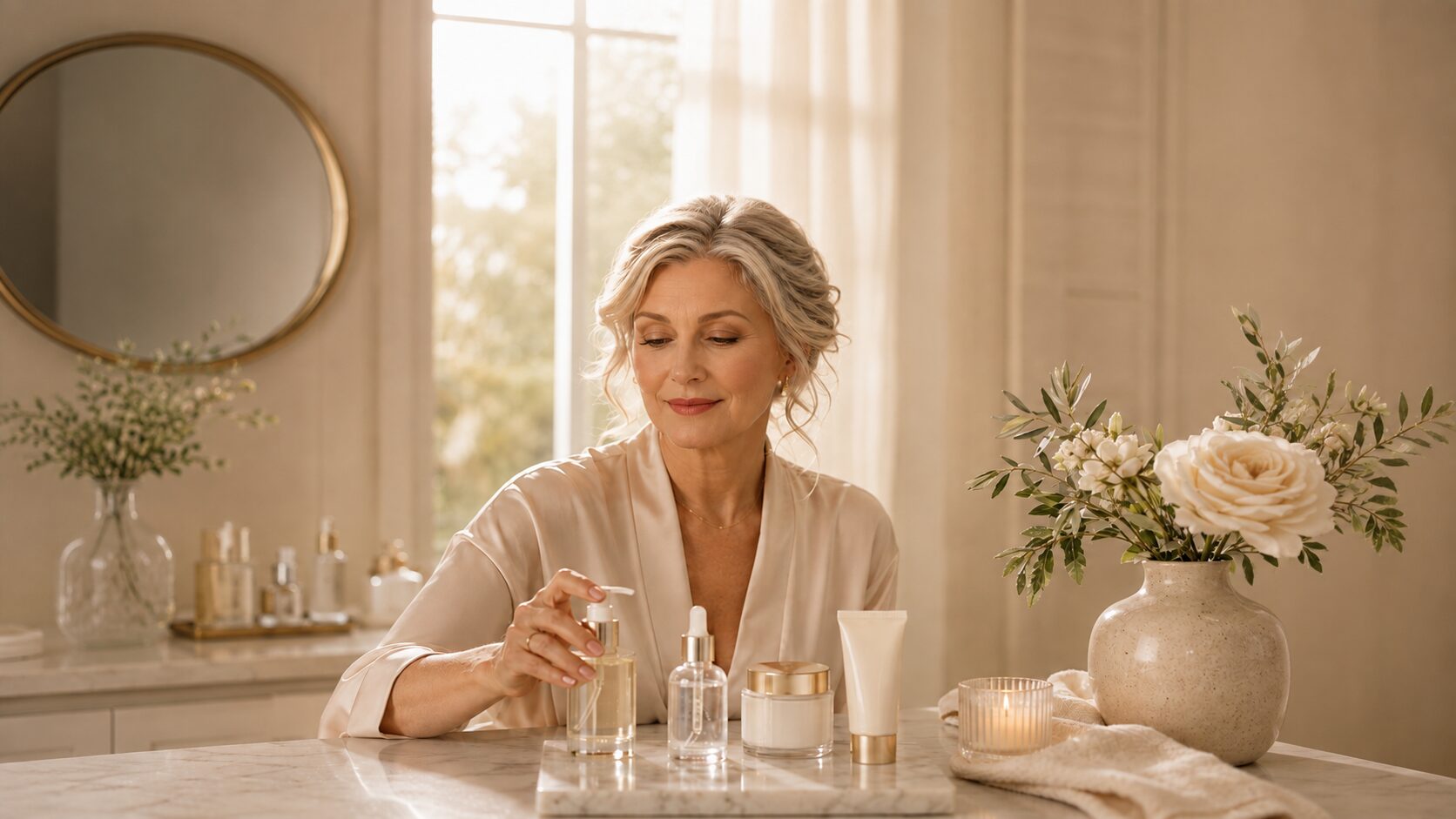
Why Fewer Skincare Products Can Give Mature Skin Better Results
August 16, 2026
She’s standing at her bathroom vanity, surrounded by cleansers, toners, essences, exfoliants, serums, eye creams, oils, moisturizers, masks, a retinoid, a vitamin C, a peptide serum, and several products she’s barely used. She’s invested real money and real effort into her skin, following recommendation after recommendation. And yet she can’t answer one basic question: which of these products is actually helping?
Owning a lot of products isn’t itself a mistake — plenty of women build a large collection thoughtfully and know exactly why each item is there. Sometimes, though, the problem isn’t that mature skin needs another product. Sometimes it needs enough calm and consistency for the products already in the routine to do their jobs. Simplifying is not about neglecting your skin — it’s about becoming more intentional with it, and about giving yourself permission to stop treating every new launch as a requirement.
Why More Skincare Can Become Less Helpful
Adding products rarely feels like a mistake in the moment. But a growing collection can quietly create its own set of problems:
- Duplicate ingredients doing the same job twice
- Too many active ingredients layered in the same routine
- More opportunities for irritation
- Difficulty identifying what actually caused a reaction
- Difficulty knowing which product produced a benefit
- Increased expense
- A morning and evening routine that becomes genuinely complicated
- Lower consistency, simply because the routine becomes burdensome
A crowded routine becomes less useful when the products overlap, irritate, confuse the purpose of the routine, or make consistency harder — it isn’t the sheer number of products alone that’s the issue. The real question is simpler: does every product serve a clear purpose, and does the complete routine remain comfortable and sustainable?
Product Overload and the Mature Skin Barrier
An overloaded routine becomes especially challenging when it includes frequent exfoliation, a retinoid, a strong vitamin C formula, multiple acids, a scrub, fragranced or potentially irritating products, and formulas that change every few weeks. None of these ingredients are automatically ‘bad’ — the difficulty arises when too many sources of irritation overlap at once, depending on formulation, frequency, and individual tolerance, a topic covered in more depth in How to Support a Compromised Skin Barrier After 50.
A few signs suggest a routine may be asking too much of the skin: tightness, stinging, burning, flaking, persistent redness, increasing sensitivity, or a product that suddenly stings when it never did before. These signs are worth taking seriously, though they aren’t a self-diagnosis of barrier damage on their own. Severe, persistent, or unexplained symptoms deserve evaluation by a qualified healthcare professional rather than another product added on top.
Product Hopping Is Keeping You From Seeing Results
Many skincare changes take real time to evaluate — the exact timeline differs by ingredient and by goal, so there’s no single number of weeks that applies to everything. Changing several variables at once makes it harder to know what’s helping, what’s irritating, and what simply hasn’t had enough time to be fairly evaluated. A temporary reaction can cause someone to abandon a genuinely useful product too quickly, and a viral recommendation can lead to replacing an entire routine before the previous one was ever fairly evaluated in the first place. Novelty can feel productive even when it’s simply creating more variables to untangle later.
If the routine changes every couple of weeks, it becomes very difficult to evaluate it fairly. Timelines differ by ingredient and goal, but the underlying principle stays the same: you can’t learn much from a routine that never holds still long enough to be evaluated.
| WONDERING WHAT ELSE MIGHT BE AFFECTING YOUR RESULTS? The free Ageless Glow guide, The 5 Hidden Reasons Your Skin Isn’t Improving After 50, helps you look at the fuller picture around your routine — not just the products themselves. GET THE FREE GUIDE → |
The Four-Product Foundation That Covers the Essentials
This is a foundational educational framework, not a prescription that every woman must follow exactly. Some women may reasonably use an eye product, more than one treatment, a hydrating serum, prescription products, or other specialty items — the four categories below simply provide an anchor to evaluate everything else against.
- Cleanser — removes makeup, sunscreen, and daily buildup without leaving skin excessively tight
- Treatment — one or more thoughtfully chosen treatment products based on your goals and tolerance, such as a retinoid, vitamin C, peptides, or niacinamide
- Moisturizer — supports hydration, comfort, and the skin barrier
- Sunscreen — protects against UV exposure and supports the rest of a healthy-aging routine
Some women reasonably need additional products, and that’s perfectly fine. The point of the four essentials is not to be a ceiling — it’s a foundation you can evaluate everything else against. A simpler starting point simply makes evaluation easier.
How to Audit Your Skincare Shelf in 15 Minutes
A calm, three-category audit can bring quick clarity to even the most crowded shelf:
Keep
Products that serve a clear purpose, are well tolerated, are used consistently, and fit naturally into your routine.
Pause
Products that duplicate another product, have no clear role, were introduced recently during a period of irritation, or are rarely used — set these aside to evaluate separately, one at a time.
Remove or Retire
Products that are expired, consistently irritate your skin, no longer fit your routine, or were purchased for a concern you no longer have.
This is a decluttering exercise, not a purge — and it’s never a reason to discard a prescription product or discontinue medical treatment without your clinician’s guidance. ‘Pause and reassess’ is often a better first step than ‘discard,’ and there’s no need to throw away expensive products unnecessarily.
| READY TO TURN THAT AUDIT INTO A CALMER ROUTINE? The Ageless Glow Starter Kit was designed to help you take an audit like this one and turn it into a genuinely simpler morning and evening routine — an organizing tool, not a treatment. EXPLORE THE AGELESS GLOW STARTER KIT → |
Do You Need a Separate Neck Cream?
The neck and décolletage genuinely deserve care, and they may be more sensitive to aggressive active ingredients than the face — worth reading more about in The Neck and Décolletage Mistakes Most Women Over 50 Make. But a dedicated neck cream is not automatically necessary. In many cases, a facial moisturizer you already use is appropriate for the neck as well, provided the formulation is suitable, the manufacturer’s directions allow it, and your neck tolerates it well. Sunscreen should extend down to the neck and upper chest regardless of which moisturizer you choose, and treatment products generally need a more cautious introduction here, since tolerance can differ from the face.
A separate neck product can make sense if you enjoy it, tolerate it particularly well, or have a specific need — but it should never be presented as mandatory. This is the less-but-better philosophy applied directly: one more product is only worth adding if it does a job nothing else in your routine is already doing.
The Luxury of Knowing Exactly What Your Skin Needs
Real skincare luxury is not necessarily owning twenty bottles, buying every new launch, reaching for the highest percentage on the shelf, or following a complicated twelve-step routine. Those things can feel productive, even indulgent, without actually making your skin any calmer. True luxury can look like something quieter: clarity, a calm vanity, products chosen intentionally, knowing exactly why each one is there, a routine that feels pleasant rather than demanding, and the simple confidence of not constantly guessing.
There’s something genuinely luxurious about opening your skincare cabinet and knowing exactly why every product is there. That feeling is very much what the Ageless Glow Starter Kit was designed to help you build.
Why Fewer Products Can Sometimes Make Skin Look Better
Simplification may help when it reduces unnecessary irritation, makes a routine easier to follow, helps you identify which products are genuinely effective, encourages consistency, supports barrier recovery, and prevents excessive exfoliation or active-ingredient stacking. For many women, a shorter routine is easier to follow consistently and easier to evaluate than an elaborate routine that changes frequently.
This doesn’t mean fewer products automatically produce better skin for everyone, and it’s not a universal rule to apply without thought. Fewer products are not inherently better. Better-chosen products usually are — and often, though not always, that means fewer of them.
A Simple Routine Is Easier to Evaluate
Before adding something new, a few honest questions can save both money and irritation:
- Why am I adding this?
- What concern am I trying to address?
- Is another product already doing the same job?
- Does this ingredient overlap with something I already use?
- Can I realistically use it consistently?
- How will I know whether it’s actually helping?
How This Fits Into the Ageless Glow Healthy Foundation Approach
Thoughtful skincare is one topic within the broader Healthy Foundation educational framework, alongside facial muscles, fascia, normal lymphatic and fluid movement, and skin-barrier health. Skincare becomes easier to evaluate when the routine itself is clear and when broader skin-health basics — barrier comfort, sun protection, consistency — aren’t being ignored, not because muscles, fascia, or lymphatics must be manually corrected first. The goal is not to make skincare insignificant. It’s to put it in perspective, alongside sleep, nutrition, hydration, movement, stress management, sun protection, and consistency — habits that complement a thoughtful routine rather than being proven, direct determinants of visible skin outcomes on their own.
Back to the Vanity
She doesn’t need to throw everything away. She simply needs to ask better questions: What does this product do? Do I already have something that does that? Does my skin tolerate it? Can I use it consistently? Is it making my routine better — or simply bigger?
The goal is not the smallest skincare routine. It is the clearest one. Healthy-looking mature skin does not come from owning the most products. It comes from understanding the ones you choose.
Before deciding which products deserve a place in your routine, it helps to understand the ingredients inside them: read The Mature-Skin Ingredient Guide: What Helps, What Irritates, and What to Use Carefully.
| THE AGELESS GLOW ONE-JOB RULE Before adding a product, be able to name the job you want it to do. If another product already performs that job well, pause before adding another. Your routine does not need more steps. It needs clear reasons for the steps you keep. |
Read Next
- The Mature-Skin Ingredient Guide: What Helps, What Irritates, and What to Use Carefully
- How to Support a Compromised Skin Barrier After 50
- The Morning Routine That Supports Healthy Aging Skin
| GET THE FREE GUIDE Ready to look a little closer at what your skin may actually be missing? The 5 Hidden Reasons Your Skin Isn’t Improving is a good place to start. GET THE FREE GUIDE → |
