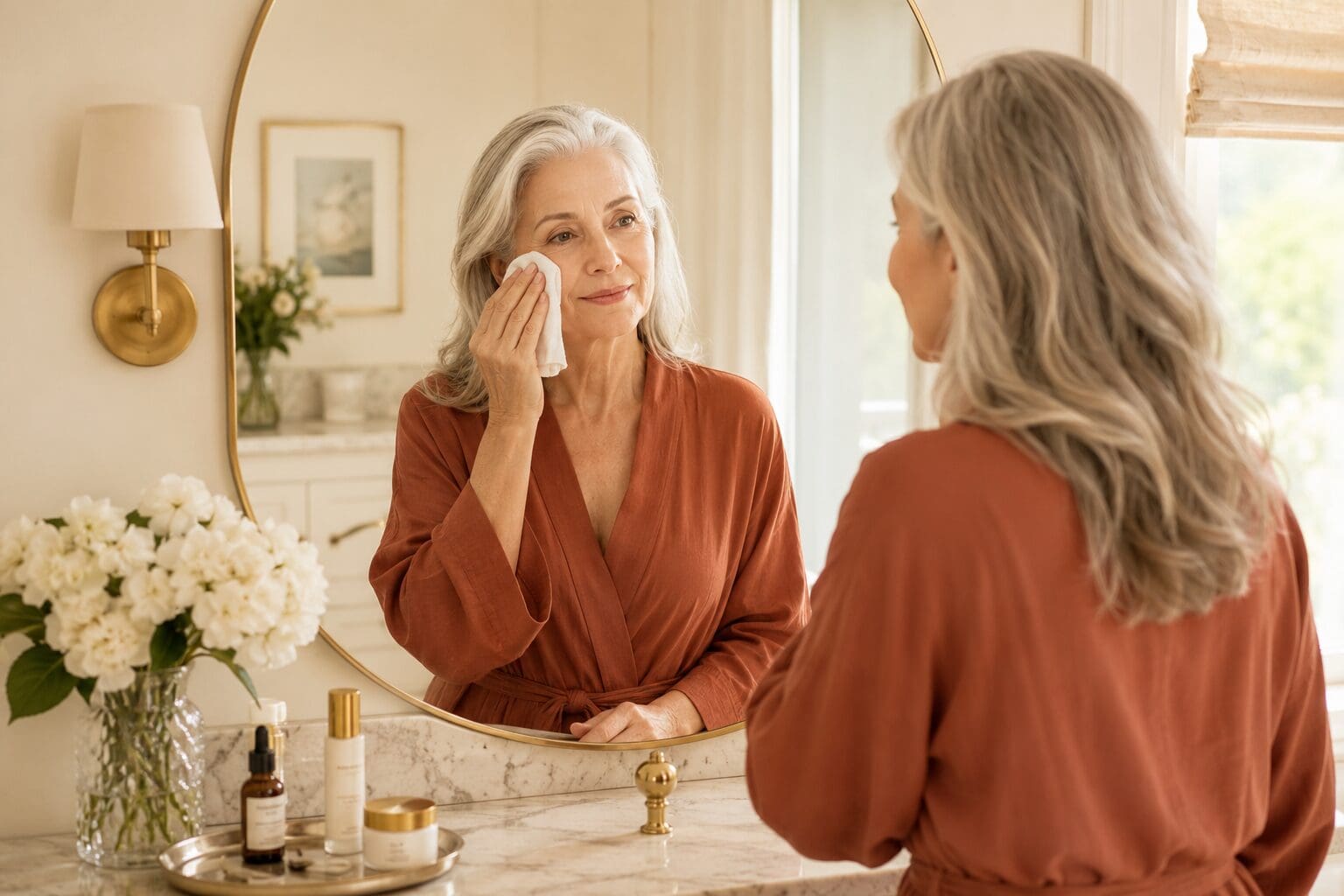
The Hidden Causes of Morning Puffiness
August 7, 2026
Some mornings, your eyes look bright and rested. Other mornings, using the very same skincare the night before, your face looks noticeably puffier in the mirror. It’s tempting to assume your routine has stopped working. More often, something else is going on — something that has little to do with the products on your shelf.
Morning facial puffiness can be influenced by normal fluid distribution during sleep, sleep quality, lifestyle factors, allergies, irritation, age-related changes, and individual anatomy. Sometimes the answer is not another product. Sometimes it’s understanding what may be happening underneath the surface.
What Morning Puffiness Actually Is
Puffiness usually refers to a temporary accumulation or redistribution of fluid within facial tissues — though it doesn’t always share the same underlying mechanism from one woman, or one morning, to the next. It can reflect normal overnight fluid shifts, individual anatomy, sleep position, allergies, irritation, dietary factors, or, in some circumstances, medication or a medical cause. It’s not a sign that something has gone wrong, and for most people, it’s a completely normal and expected part of how the body settles after hours spent lying down.
The under-eye area shows these fluid changes more easily than almost anywhere else on the face, largely because the skin there is thin and the underlying tissue is delicate. Puffiness may also become more noticeable with age, as gradual changes in skin thickness, elasticity, fat distribution, and supporting tissue can make ordinary fluid shifts more visible than they once were — though this varies by individual, and it doesn’t mean every woman over 50 develops impaired lymphatic function. Not all puffiness is caused by the lymphatic system, and it rarely has one tidy explanation.
What the Lymphatic System Does
The lymphatic system is part of the body’s immune and fluid-management network. It helps move excess fluid, proteins, and cellular material through vessels that run throughout the body, including the face. Lymph transport is supported by both intrinsic contractions within lymphatic vessels themselves and external forces such as body movement, skeletal-muscle activity, and breathing — in other words, the lymphatic system is not passive, and it doesn’t sit still unless it’s manually massaged. Movement may contribute to normal lymph transport, but that doesn’t mean you need to manually ‘activate’ or ‘pump’ your lymphatic system every morning.
Facial lymphatic vessels are simply one regional part of this larger, body-wide system. It’s not accurate to say lymph becomes ‘clogged,’ that the face fills with toxins, or that a massage technique ‘detoxes’ the skin. A more honest way to put it: gentle movement and light touch may support normal fluid movement in some people, but facial puffiness has many possible causes — the lymphatic system is only one piece of the picture.
| WONDERING WHAT ELSE MIGHT BE AFFECTING YOUR RESULTS? The free Ageless Glow guide, The 5 Hidden Reasons Your Skin Isn’t Improving After 50, helps you look at the fuller picture around your routine — not just the products themselves. GET THE FREE GUIDE → |
The Hidden Causes of Morning Puffiness
Puffiness is rarely caused by one single factor. More often, it reflects a combination of the following — some within your control, many simply part of being human.
1. Sleeping Position
Lying flat for several hours changes how fluid distributes through the body, and gravity is part of that story. Some people notice more facial puffiness after sleeping flat, or face-down with a cheek pressed into the pillow. This doesn’t mean one position is universally best for facial aging or lymphatic health — only that position is one variable worth noticing.
2. Sodium and the Previous Evening’s Meal
A higher-sodium meal the night before may temporarily increase fluid retention in some people. This isn’t a reason to view sodium as inherently harmful or something to medically restrict — it’s simply one everyday factor that can shift how your face looks the following morning.
3. Alcohol
Alcohol can influence hydration, sleep quality, blood vessel behavior, and fluid balance, all of which may show up as morning puffiness. This is a straightforward physiological pattern, not a detoxification issue.
4. Poor or Interrupted Sleep
A restless night can affect how rested your face looks the next morning. Fatigue, under-eye darkness, and puffiness often appear together, but they aren’t necessarily caused by the same mechanism — poor sleep simply tends to affect several aspects of appearance at once, rather than directly causing facial lymphatic stagnation.
5. Allergies and Nasal Congestion
Seasonal allergies, sinus congestion, and general eye irritation can all contribute to temporary under-eye swelling. If symptoms are persistent, severe, or accompanied by other concerns, it’s worth having them evaluated by a healthcare professional rather than assuming skincare alone can address them.
6. Skin Irritation
Over-exfoliation, strong retinoids, fragrance sensitivity, eye rubbing, aggressive tools, or a recent treatment can leave skin looking swollen or reactive rather than simply fluid-puffy. If this sounds familiar, it may be worth reading How to Support a Compromised Skin Barrier After 50, since protecting the barrier is often the more relevant fix — not another lymphatic technique. Fluid-related puffiness and swelling or reactivity from irritation are genuinely different things, and lymphatic massage isn’t the right response to irritated or inflamed skin.
| READY TO SIMPLIFY THE SKINCARE SIDE OF YOUR ROUTINE? If irritation from too many products is part of what’s going on, the Ageless Glow Starter Kit can help you simplify and organize your routine around what your skin actually tolerates — a practical tool, not a treatment for puffiness or lymphatic function. EXPLORE THE AGELESS GLOW STARTER KIT → |
7. Hormonal and Age-Related Changes
Hormonal shifts and gradual changes in facial tissue may affect how puffiness appears over time. It would be an overstatement to say menopause ‘causes lymphatic stagnation’ — the reality involves several interconnected changes in skin and tissue structure, and it deserves a realistic explanation rather than a dramatic one.
8. Crying, Stress, and Everyday Life
Crying, stress, disrupted sleep, travel, an unusual meal, or simply a long day can all temporarily influence how your face looks the next morning. One puffy morning is not a skincare failure, and it rarely means anything more than that yesterday was a full day of being human.
What Gentle Morning Habits May Help
A few unhurried habits may support comfort on a puffier morning. If you’d like to understand more about how habitual jaw and facial tension plays into this picture, What Facial Tension May Be Doing to the Way Your Face Looks is a helpful place to start.
- Sit upright and give your body a few minutes to adjust after waking
- Drink water normally, according to thirst and your usual hydration habits
- Relax the jaw, neck, and shoulders
- Use a cool — not painfully cold — compress around the eyes if it feels soothing
- Use feather-light facial touch rather than aggressive rubbing
- Take a short walk or do a few minutes of gentle whole-body movement
- Follow with a calm, barrier-friendly skincare routine
These habits may support comfort and give temporary puffiness time to settle on its own. They don’t reliably ‘flush toxins’ or ‘drain’ the face in a way you need to manage — they simply give your body a gentle, unhurried start to the day.
A Gentle Facial Fluid-Balance Ritual
If you enjoyed the gentle massage approach discussed in Fascia and the Face: What Women Over 50 Should Understand, this short ritual builds on the same principle of comfort over intensity, applied specifically to a puffier morning.
- Begin with clean hands
- Relax your shoulders and jaw
- Use extremely light pressure — barely more than the weight of your fingertips
- Use broad, slow, feather-light, comfortable movements, with enough slip to avoid dragging the skin
- Avoid pressing deeply or repeating movements over irritated areas
- Stop immediately if you notice pain, irritation, dizziness, or discomfort
This ritual is intended for comfort. It is not a proven treatment for facial edema and it is not medical lymphatic drainage.
Clinical manual lymphatic drainage (MLD) is a specialized therapeutic technique performed by trained practitioners in certain medical or rehabilitation settings, and it’s meaningfully different from a casual facial massage performed at home for comfort. An at-home ritual like this one isn’t equivalent to professional MLD, shouldn’t be marketed as such, and isn’t required for ordinary morning puffiness.
What Not to Do
A few common pieces of online advice are worth avoiding altogether:
- Aggressive scraping
- Hard gua sha pressure
- Prolonged facial pulling
- Massage that causes pain
- Extreme cold applied directly and repeatedly
- Repeated manipulation of already-irritated skin
- “Detox” protocols marketed specifically for facial puffiness
More pressure does not mean better results. If anything, it tends to move you further from the comfort you were originally looking for. This isn’t a case against gua sha or facial massage generally — done gently, they can be a pleasant part of your routine; it’s specifically about avoiding the aggressive versions of these techniques.
When Puffiness Deserves Medical Attention
Occasional, mild morning puffiness is common and rarely a cause for concern. That said, certain patterns are worth having evaluated by a healthcare professional rather than managed at home:
- Sudden or severe swelling
- Swelling on only one side of the face, particularly when new or significant
- Swelling accompanied by difficulty breathing
- Swelling with hives or other signs of an allergic reaction
- Eye pain or changes in vision
- Redness, warmth, or signs of possible infection
- Facial swelling that persists rather than settling within the day
- New swelling that began alongside a new medication or medical condition
This list isn’t meant to alarm you — most mornings, puffiness is simply puffiness. It’s meant to help you recognize the less common situations where a professional opinion is the better next step. If you experience difficulty breathing or other signs of a serious allergic reaction, seek urgent medical attention rather than waiting for a routine appointment.
What Women Can Realistically Expect
With gentle, consistent habits, some women may notice a temporary reduction in mild puffiness, greater comfort, improved awareness of where you hold tension, a calmer morning routine, and simply feeling more refreshed. These are modest, believable outcomes — and worth having.
It’s not reasonable to expect permanent facial slimming, ‘detoxification,’ a sculpted jawline, permanent lifting, elimination of under-eye bags, fat loss, or a reversal of facial aging. No morning ritual, however soothing, produces those results. Persistent under-eye bags in particular may reflect anatomy or structural changes in the tissue rather than fluid that can simply be moved or drained away.
How This Fits Into the Ageless Glow Healthy Foundation Approach
Normal lymphatic and fluid movement is the third topic we’re exploring in the Healthy Foundation series, following facial tension and fascia. Facial muscles shape how we hold and move the face, fascia describes the connective tissue between deeper structures, lymphatic health concerns normal fluid movement, the skin barrier provides protection and moisture retention, and thoughtful skincare supports all of it rather than overwhelming it.
These topics are genuinely interconnected. But the Ageless Glow Healthy Foundation approach is an educational way of organizing mature-skin care — not a claim that any one system can be manually manipulated to reverse the aging process, and not a series of anatomical layers where one must be fixed before the next.
A Reassuring Conclusion
Your face is allowed to look different from one morning to the next. Puffiness is often temporary, and it’s not automatically a sign that something is wrong — or that you need another product. Understanding the possible contributors simply gives you a calmer, more informed way to respond.
Next in the Healthy Foundation series, we’ll look at the skin barrier — and why mature skin often needs protection before it needs another active ingredient.
| MORNING PUFFINESS REMINDER Morning puffiness is often temporary and can be influenced by sleep, fluid balance, allergies, irritation, and everyday habits. Gentle support is usually more appropriate than aggressive facial manipulation. |
Read Next
- What Facial Tension May Be Doing to the Way Your Face Looks
- Fascia and the Face: What Women Over 50 Should Understand
- How to Support a Compromised Skin Barrier After 50
| GET THE FREE GUIDE Ready to look more closely at what your skin may actually need? The 5 Hidden Reasons Your Skin Isn’t Improving After 50 is a calmer, clearer way to evaluate your routine. GET THE FREE GUIDE → |
