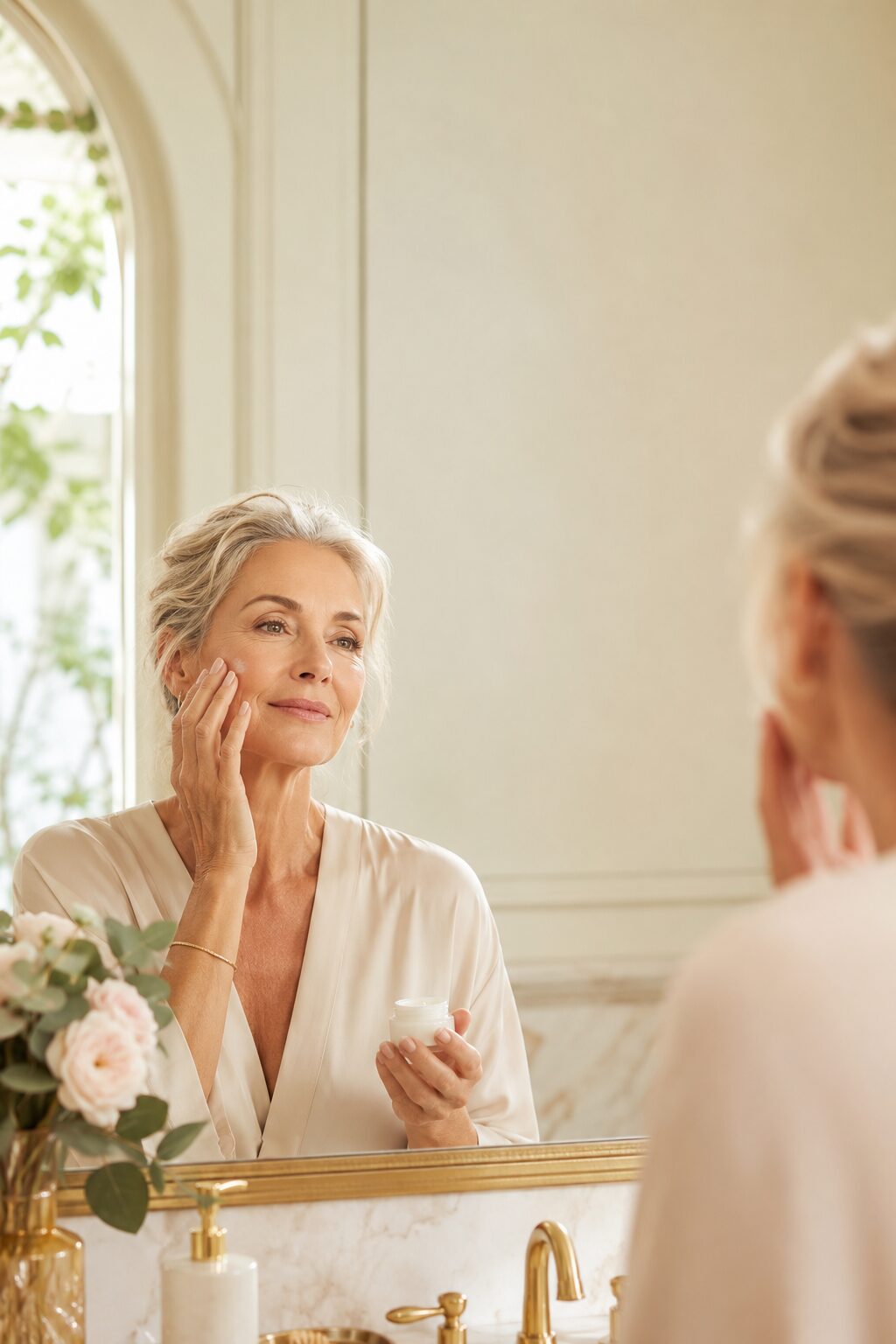
The Biggest Anti-Aging Mistakes Women Make After 50
August 2, 2026
After fifty, the skincare landscape changes — and what worked well in your thirties and forties may genuinely not be the right approach anymore. The mistakes on this list aren’t about willpower or effort. They’re about information. Most women making them are working hard; they’re simply working with an outdated map.
Mistake 1: Treating Mature Skin Like It’s Still Young Skin
Skin often becomes drier and may become more sensitive or barrier-vulnerable with age and menopause — though women over 50 are not one uniform skin type, and needs vary widely from woman to woman. Routines built around controlling oil, preventing breakouts, or frequent aggressive exfoliation aren’t automatically wrong after 50, but they’re worth reassessing against what your skin is actually asking for now, rather than what it needed a decade or two ago.
If you’re using a foaming cleanser that leaves your skin feeling ‘clean’ but tight, an exfoliating acid more often than your skin comfortably tolerates, or a lightweight lotion when your skin clearly wants something richer, it may be worth asking whether you’re applying an earlier framework to skin that has changed.
| THE REFRAME Ask not ‘Is this product good?’ but ‘Is this product appropriate for my skin right now?’ Think of it as an editorial principle rather than a hard rule: mature skin often does well with a support-first approach, though it can still benefit from appropriately chosen, well-tolerated active ingredients. |
| WONDERING WHAT ELSE MIGHT BE AFFECTING YOUR RESULTS? The free Ageless Glow guide, The 5 Hidden Reasons Your Skin Isn’t Improving After 50, helps you look at the fuller picture around your routine — not just the products themselves. GET THE FREE GUIDE → |
Mistake 2: Changing Products Too Often to See Results
Many skincare changes require sustained, consistent use before they can be judged fairly — different ingredients, concerns, formulations, and individual skin all have their own timelines, so there’s no single universal number of weeks that applies to everything. What’s more consistent is this: irritation or intolerance often becomes apparent much sooner than genuine benefit does, which is exactly why patience and careful observation both matter.
The pattern of switching products every few weeks — before any meaningful, fair trial has been completed — is one of the most common and costly habits in mature skincare. A cabinet full of half-used products is almost always a cabinet full of things that were never given a real chance.
The main idea worth holding onto: don’t change multiple products at once before you can reasonably tell what’s helping, what’s irritating, and what simply needs more time.
| READY TO STOP GUESSING AND START EVALUATING? If your cabinet has become a graveyard of half-used products, the Ageless Glow Starter Kit can help you audit what you already own and build a simpler, more purposeful routine you can actually evaluate. EXPLORE THE AGELESS GLOW STARTER KIT → |
Mistake 3: Neglecting the Neck and Chest
The face ends at the jawline in most women’s skincare routines. The visible aging process doesn’t share that boundary. The neck and décolletage have thinner skin and fewer oil glands, and they’re exposed to real UV through daily outdoor time, incidental daylight, and UVA that can pass through some window and vehicle glass — often with considerably less protection and far less product attention than the face receives.
Moisturizer and appropriate sun protection should generally extend to the neck and any exposed chest area. Stronger actives, though, are worth introducing more cautiously in these areas — the skin here tends to be thinner and more irritation-prone, so following product directions and adjusting based on your own tolerance matters more than mirroring your entire face routine step for step.
Mistake 4: Skipping SPF on Cloudy or Indoor Days
UV radiation can penetrate cloud cover more than people expect, and UVA — a wavelength linked to collagen breakdown and premature aging — can pass through glass. If you spend significant time near bright windows or driving, your UV exposure may be more meaningful than it feels; someone who spends the day well away from windows will generally have less.
Broad-spectrum SPF 30 or higher, applied every morning, remains one of the most consistently useful habits available to every woman, at every price point. It’s also, understandably, one of the easiest habits to talk yourself out of on days that seem to call for it least — which is exactly why it’s worth keeping simple and automatic rather than something you decide about each morning.
Mistake 5: Addressing the Face in Isolation
Skin doesn’t exist separately from the rest of your life. Hydration, nutrition, sleep quality, stress, and general health all belong in a broader healthy-aging picture, and it’s reasonable to think of your skincare as one part of that picture rather than the whole of it.
That said, it’s worth being careful here: evidence connecting any single one of these factors to visible skin outcomes varies quite a bit, and individual effects differ. Topical skincare, sun protection, and — when appropriate — dermatologic care remain genuinely effective on their own; broader wellness habits complement that care rather than replace it or serve as a substitute treatment.
Healthy skin is influenced by more than what’s in the bathroom cabinet — but that doesn’t mean every wellness habit is a skincare treatment, or that skipping any one of them puts a hard ceiling on what good skincare can do for you.
Mistake 6: Comparing Progress to the Wrong Standard
The skincare industry, social media, and beauty advertising offer a single standard of comparison: younger skin. When women over fifty measure their progress against that benchmark, they’re measuring something that isn’t — and shouldn’t be — the goal.
The goal is your best possible skin, at this stage of your life, with the foundation you have. That’s a real, achievable, and genuinely beautiful outcome. It’s undermined every time it’s measured against a standard designed for a different body at a different time.
You are not trying to reverse time. You are trying to work with what you have, intelligently and consistently. That is a completely different — and entirely achievable — goal.
The Pattern Underneath the Mistakes
Nearly every mistake on this list has a common root: approaching mature skincare with outdated assumptions, unrealistic timelines, or a framework borrowed from a different stage of life. The solution isn’t more effort — it’s a more accurate map.
A better approach to mature skin isn’t built around doing more. It’s built around understanding what your skin needs now, protecting its foundation, and choosing each step with a clear purpose — the idea at the center of the Ageless Glow Healthy Foundation approach.
Read Next
- The Morning Routine That Supports Healthy Aging Skin
- How to Rebuild a Struggling Skin Barrier After 50
- Why Fewer Skincare Products Can Give Mature Skin Better Results
| GET THE FREE GUIDE If you’d like a clear, straightforward guide to understanding what may actually be preventing your skin from improving — written specifically for women over fifty — The 5 Hidden Reasons Your Skin Isn’t Improving After 50 is a good place to begin. GET THE FREE GUIDE → |
